
Moving freight between the U.S. and Canada comes down to one thing: having your paperwork ready before the truck reaches the border.
The two processes that make that possible are PARS for freight entering Canada and PAPS for freight entering the United States. When everything is filed correctly, customs can review the shipment before arrival and the truck can cross with minimal delay. When documents are missing, unclear, or mismatched, freight can sit at the border while your customer waits.
Varstar Alliance helps shippers move cross-border freight across the U.S.–Canada border with PARS/PAPS coordination, documentation support, and cross-border carrier capacity built into the process.
This guide explains how cross-border freight actually works, which documents you need, what has changed for shippers in 2026, and how to avoid the delays that cost you money.
What is the difference between PARS and PAPS?
PARS and PAPS are pre-arrival processing systems that allow customs to review shipment information before the truck arrives at the border.
PARS, or Pre-Arrival Review System, is used by the Canada Border Services Agency for freight entering Canada.
PAPS, or Pre-Arrival Processing System, is used for freight entering the United States through U.S. Customs and Border Protection.
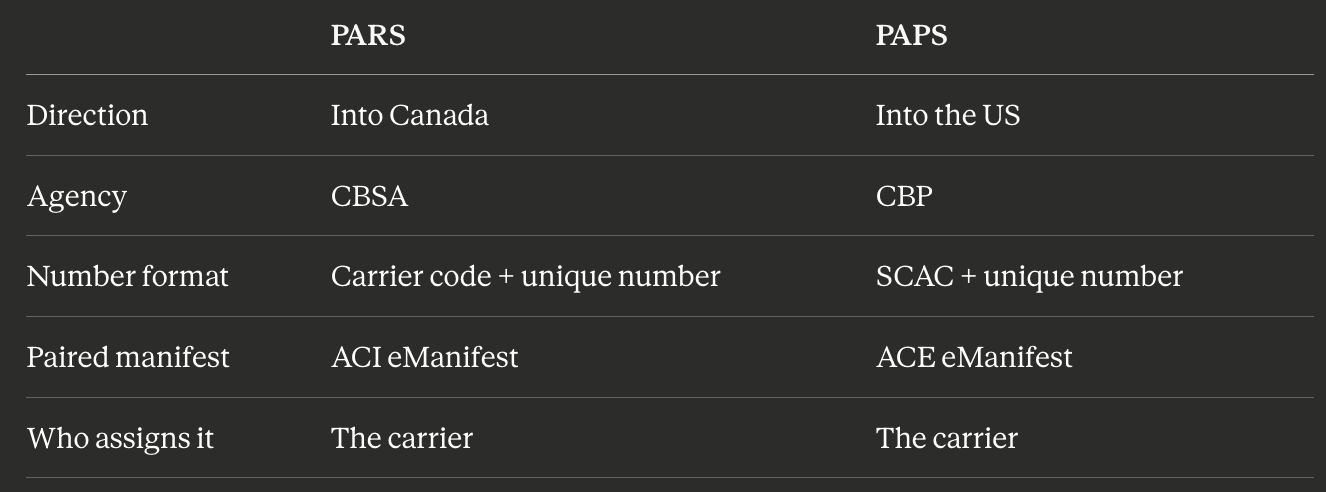
The idea is similar in both directions: the carrier assigns a barcode or shipment number, the customs broker submits the release information, and customs reviews the shipment before arrival.
On a round trip, a carrier may use both systems: a PAPS number when entering the U.S. and a PARS number when entering Canada.
How the cross-border process actually works
Here is the typical sequence for a truckload crossing between the U.S. and Canada:
The carrier assigns a PARS or PAPS number.
The barcode or shipment number is connected to the freight and added to the shipment documents, usually the commercial invoice or bill of lading.Documents are sent to the customs broker.
The broker reviews the paperwork and submits the customs release request to the correct agency: CBSA for Canada-bound freight or CBP for U.S.-bound freight.The carrier files the electronic manifest.
For Canada-bound shipments, this is done through ACI/eManifest. For U.S.-bound shipments, it is done through ACE Truck Manifest.Customs reviews the shipment before arrival.
If the information is accepted, the shipment can be ready for release when the truck reaches the border. If something is unclear, missing, or mismatched, the truck may be delayed or referred for inspection.The driver arrives at the border.
The officer verifies the shipment information, scans or checks the barcode, and either releases the freight or refers it for additional review.
The most important point: the border crossing does not start at the border. It starts at pickup, with clean paperwork and proper coordination between the shipper, carrier, and customs broker.
eManifest timing: when does it need to be filed?
For Canada-bound highway freight, ACI/eManifest cargo and conveyance data must be received and validated by CBSA at least one hour before the truck arrives at the first port of arrival.
For U.S.-bound freight, ACE Truck Manifest is generally required at least one hour before arrival. Some qualifying FAST shipments may use a shorter 30-minute advance filing window.
Because rules can vary by shipment type, carrier status, and program eligibility, the safest approach is simple: file early, confirm acceptance, and do not wait until the truck is already close to the border.
The documents you need for U.S.–Canada freight
Before the truck reaches the border, you should have the core shipment documents ready and checked.
The main documents are:
Commercial Invoice
This includes the shipper, consignee, buyer, seller, product description, value, currency, country of origin, and other key details customs needs to review the shipment.
Bill of Lading
This is the contract of carriage between the shipper and carrier. It confirms what is being transported, where it is going, and who is responsible for the freight.
Packing List
This gives a more detailed breakdown of the shipment contents, packaging, weights, quantities, and handling details.
Depending on the shipment, you may also need:
CUSMA/USMCA certification of origin
This is used when the importer wants to claim preferential duty treatment under CUSMA/USMCA. There is no single required form, but the certification must include the required data elements and can appear on an invoice or another document.
Permits or licenses
Some regulated products may require additional permits, approvals, or agency-specific documentation.
The details matter. A vague product description like “parts” or “clothing” can create problems. A better description would be something like “women’s cotton knit sweater, blue, size M” or “steel automotive bracket for passenger vehicle assembly.”
The clearer the paperwork, the faster the review.
What changed for cross-border shippers in 2026?
Cross-border freight is operating in a more complex environment than it was a few years ago.
First, tariffs remain an important planning factor. Canada removed most counter-tariffs on U.S. goods effective September 1, 2025, but countermeasures on steel, aluminum, and automobiles remain in place.
Second, CUSMA/USMCA is under review in 2026. That does not mean the agreement disappears overnight, but it does create planning uncertainty for companies that rely on North American supply chains.
For shippers, the practical takeaway is clear: review your products, confirm which goods qualify for preferential duty treatment, and make sure the right certification of origin is available before the shipment moves.
Third, cross-border capacity is under pressure. Canada has increased enforcement around driver misclassification, often referred to as “Driver Inc.” As non-compliant low-cost capacity comes under more scrutiny, some lanes may see tighter capacity and firmer pricing.
That makes planning ahead more important. Waiting until the last minute to find cross-border coverage can expose shippers to higher rates, fewer options, and more execution risk.
How to avoid the most common border delays
Most cross-border delays are preventable. They usually come from paperwork errors, late submissions, unclear product descriptions, or poor coordination between the shipper, carrier, and customs broker.
Here is how to reduce the risk:
Engage your customs broker before the truck leaves.
Do not wait until the driver is close to the border. The broker should have the documents early enough to review, correct, and submit them.
Check the commercial invoice carefully.
Make sure the product description, declared value, currency, country of origin, shipper, consignee, and buyer/seller information are accurate.
Use specific product descriptions.
Avoid vague terms like “samples,” “parts,” “goods,” or “clothing.” Customs needs enough detail to understand what the product is.
Confirm CUSMA/USMCA eligibility before claiming preferential treatment.
Do not assume a product qualifies just because it ships between the U.S. and Canada. Rules of origin matter.
File the eManifest early.
For Canada-bound freight, the one-hour rule is the minimum, not the ideal. Early filing gives time to fix issues before the truck reaches the border.
Work with vetted cross-border carriers.
Cross-border freight is not the place to rely only on the cheapest available truck. The carrier, driver, documentation process, and broker coordination all matter.
Why shippers choose Varstar for cross-border freight
Cross-border U.S.–Canada freight is one of Varstar Alliance’s core service areas. We help shippers coordinate the moving parts that matter before the truck reaches the border.
That includes:
PARS/PAPS coordination built into the workflow
We help make sure shipment information is prepared and shared before the truck is already at the crossing.
Documentation support before pickup
We work to identify missing or unclear information early, so paperwork issues do not become border delays.
Access to dedicated and vetted cross-border capacity
Not just last-minute spot coverage in a tight market.
Nearshore support aligned to U.S. business hours
Our support structure helps with tracking, communication, and exceptions across a longer coverage window.
Lane planning based on real market conditions
Cross-border pricing can shift quickly. We help shippers plan with capacity, timing, and execution risk in mind.
The bottom line
The border is not where cross-border freight succeeds or fails. The real work happens before the truck arrives.
Clean documents, an engaged customs broker, an eManifest filed on time, and a border-experienced carrier are what separate a smooth crossing from a costly delay.
In a 2026 market shaped by tariff changes, CUSMA/USMCA review, and tighter capacity on some lanes, planning ahead is no longer optional.
For shippers moving freight between the U.S. and Canada, the best strategy is simple: prepare early, verify the details, and work with a provider that understands the border.
Frequently Asked Questions
What is the difference between PARS and PAPS?
PARS is used for freight entering Canada through CBSA. PAPS is used for freight entering the United States through CBP. The process is similar, but the direction, agency, and shipment number format are different.
Do I need a customs broker to ship between the U.S. and Canada?
In practice, yes. A customs broker submits the release request, reviews documentation, and coordinates clearance with customs. Most carriers and logistics providers work with trusted customs brokers for cross-border freight.
How long does customs clearance take?
If documents are complete, the broker entry is accepted, and the manifest is filed correctly, a truck can cross with minimal delay. If documents are missing, inaccurate, or mismatched, the shipment can be held for review or referred for inspection.
Does my freight still get inspected if PARS or PAPS is accepted?
Yes. PARS and PAPS help speed up processing, but customs officers can still inspect any shipment at their discretion.
What documents do I need to ship freight to Canada?
The main documents are the commercial invoice, bill of lading, and packing list. Depending on the goods, you may also need a CUSMA/USMCA certification of origin and any required permits or licenses.
What is the eManifest and when must it be filed?
The eManifest is the carrier’s electronic cargo and conveyance data. For Canada-bound highway freight, ACI/eManifest data must be received and validated by CBSA at least one hour before arrival. For U.S.-bound freight, ACE Truck Manifest is generally required at least one hour before arrival, with a shorter 30-minute window available for some qualifying FAST shipments.
Did tariffs change for U.S.–Canada freight?
Yes. Canada removed most counter-tariffs on U.S. goods effective September 1, 2025, but tariffs on steel, aluminum, and automobiles remain in place. Because CUSMA/USMCA is under review in 2026, shippers should review product eligibility, rules of origin, and documentation before moving freight.