
Short answer: Asset-based providers own their trucks and give you tighter control on the lanes their fleet covers. Non-asset brokers own no trucks but give you far broader capacity through a vetted carrier network. Most shippers get the best result from a partner that runs an asset-based operating discipline with non-asset reach.
| Asset-based provider | Non-asset freight broker | |
|---|---|---|
| Owns trucks | Yes | No |
| Capacity ceiling | Limited to its own fleet | Scales across thousands of carriers |
| Lane coverage | Strong where the fleet runs | Nationwide and cross-border |
| Pricing in a tight market | More stable on contracted lanes | Market-driven, but more options to source |
| Control of service | Direct over drivers and equipment | Depends on carrier vetting and oversight |
| Best for | Recurring, specialized, dedicated lanes | Surges, irregular freight, wide geography |
Choose asset-based when you have steady, repeatable lanes and specialized equipment needs. Choose a non-asset broker when your volume swings, your lanes move, or you need cross-border coverage a single fleet cannot deliver.
Choosing the right freight partner is not just about who gives you the lowest rate.
It is about who can actually cover your freight when capacity gets tight, documents need to be right, and your customer is waiting.
One of the most common comparisons shippers make is between asset-based providers and non-asset freight brokers. Asset-based providers operate their own trucks and equipment. Non-asset brokers arrange freight through a network of third-party carriers.
Both models can work. The right choice depends on your freight, your lanes, your service requirements, and how much flexibility you need.
At Varstar Alliance, our focus is simple: giving shippers access to dedicated and vetted cross-border capacity - not just last-minute spot coverage in a tight market.
This guide explains the difference between asset-based and non-asset freight providers, when each model makes sense, and what shippers should look for before awarding freight.
What is an asset-based freight provider?
An asset-based freight provider owns and operates transportation equipment such as trucks, trailers, and sometimes warehouses or terminals.
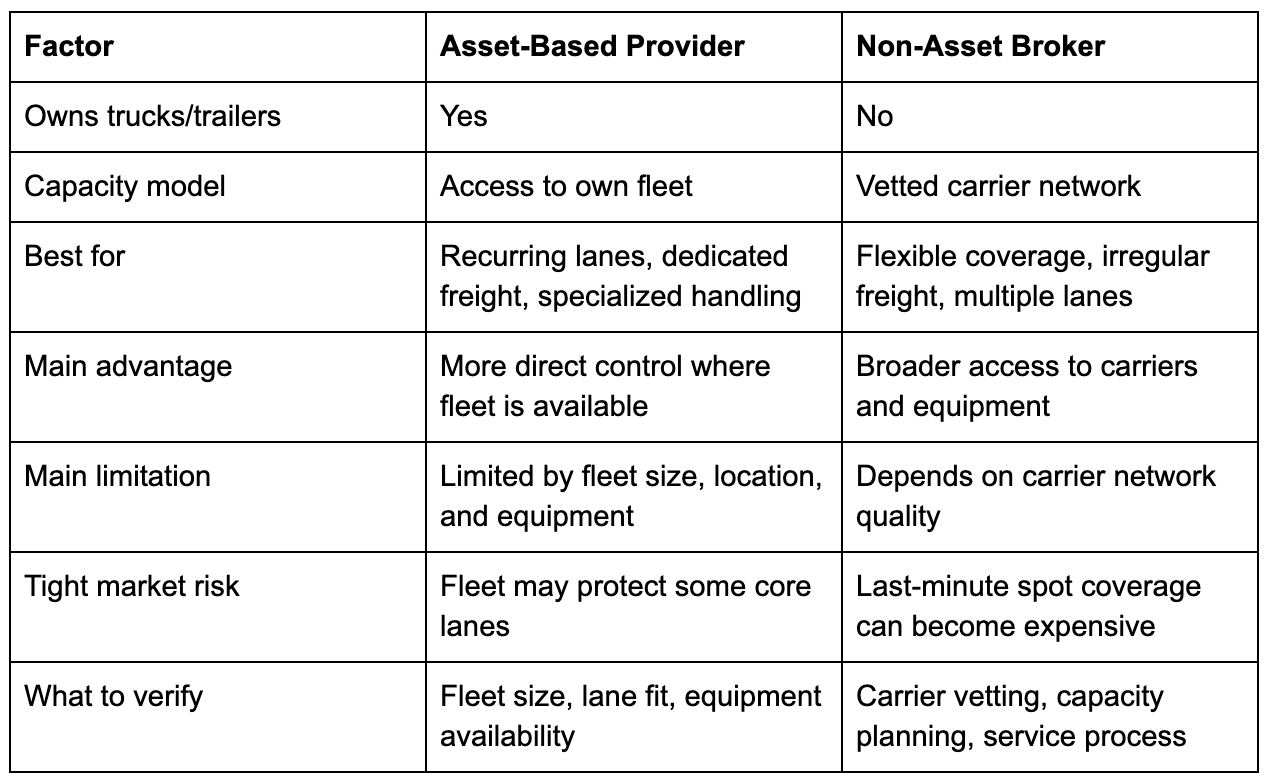
Because they control their own equipment and drivers, asset-based providers can offer more direct control on the lanes where their fleet is available. This can be useful for recurring shipments, specialized freight, dedicated lanes, or freight that needs a very consistent operating process.
The trade-off is that asset-based capacity is usually limited to the provider’s fleet size, equipment mix, geography, and availability.
What is a non-asset freight broker?
A non-asset freight broker does not own the trucks moving your freight. Instead, the broker arranges transportation through a network of qualified carriers.
A strong non-asset broker can offer broad coverage, flexibility, and access to many equipment types across different regions. This can be especially useful for irregular freight, seasonal spikes, one-off shipments, or lanes where a single fleet would not be enough.
The trade-off is that service quality depends heavily on carrier vetting, relationships, communication, and the broker’s ability to secure capacity before the load becomes urgent.
The real difference: control vs. access
The simplest way to understand the difference is this:
Asset-based providers offer more direct control where their fleet is available.
Non-asset brokers offer broader access through carrier relationships.
Neither model is automatically better. What matters is whether the provider can give you reliable coverage for the freight you actually move.
For shippers, the real question is not only, “Do you own trucks?”
The better question is:
Can you give me reliable access to the right capacity, on the right lane, at the right time?
That is especially important in cross-border freight, where the carrier needs more than an available truck. They also need border experience, documentation discipline, communication, and the ability to handle exceptions quickly.
Asset-based vs. non-asset freight broker: quick comparison
When asset-based capacity makes sense
Asset-based capacity can be a strong fit when your freight is predictable and consistent.
It may make sense when:
You run the same lanes every week.
You need dedicated equipment or consistent drivers.
You move specialized freight such as refrigerated, food-grade, high-value, or time-sensitive shipments.
You need a highly controlled process.
Your freight volume is stable enough to support committed capacity.
For this type of freight, direct control can reduce uncertainty. If the provider’s equipment is available on your lanes, asset-based capacity can help protect service levels and reduce last-minute coverage risk.
But asset-based is not always the best answer. If your freight changes often, moves across many regions, or requires different equipment types, one fleet may not give you enough flexibility.
When a brokered model makes sense
A brokered model can be the better fit when flexibility matters more than fixed capacity.
It may make sense when:
Your freight is irregular or seasonal.
You ship across many origins and destinations.
Your volume changes from week to week.
You need different equipment types.
You need overflow support beyond your normal carrier base.
You want one logistics partner to coordinate multiple carrier options.
A good broker does more than “find a truck.” A good broker builds relationships with reliable carriers, understands lane conditions, checks safety and compliance, communicates clearly, and helps prevent surprises before they happen.
That is the difference between professional capacity planning and last-minute spot coverage.
Why dedicated and vetted capacity matters in a tight market
When the market tightens, the cheapest truck is usually not the safest strategy.
Capacity gets harder to find. Spot rates can move quickly. Carriers become more selective. Loads that looked easy to cover can suddenly become expensive or unreliable.
That is when dedicated and vetted capacity matters most.
Shippers who plan ahead with trusted carrier relationships are in a stronger position than shippers who wait until the last minute and compete for whatever trucks are left.
Dedicated and vetted capacity helps with:
More reliable coverage
Better communication
Fewer last-minute rate surprises
More consistent service
Stronger carrier accountability
Better planning for recurring lanes
This is especially important for U.S.–Canada cross-border freight, where service depends on the right carrier, the right documents, the right timing, and border experience.
What shippers should ask before awarding freight
Before choosing a freight broker or logistics partner, ask these questions:
How do you secure capacity for my lanes?
You want to understand whether the provider is relying only on the spot market or whether they have planned carrier relationships for your freight.How do you vet your carriers?
Ask about safety, compliance, insurance, service history, equipment fit, and cross-border experience.Can you support recurring or dedicated lanes?
If your freight moves consistently, your provider should be able to create a more stable coverage plan.What happens when the market tightens?
A serious provider should have a capacity plan, not just a promise to “check the load board.”Do you have cross-border experience?
For U.S.–Canada freight, carrier selection matters. The right partner should understand PARS/PAPS coordination, customs documentation, eManifest timing, and border execution.How do you communicate when something goes wrong?
Freight does not always move perfectly. What matters is how quickly your provider sees the issue, communicates it, and works on a solution.
If a provider cannot answer these questions clearly, you may be taking on more risk than you think.
Where Varstar Alliance fits: asset-based discipline, non-asset reach
Varstar Alliance is a Detroit-based asset-based freight broker that runs like a carrier without being limited to one fleet. We operate with an asset-based discipline - dedicated capacity commitments, contracted lanes, direct dispatcher oversight, and accountable carrier partners - while keeping the nationwide and U.S.-Canada reach of a vetted carrier network.
We do not position our value around claiming ownership of every truck. Our value is helping shippers access the right capacity for the job through dedicated and vetted carrier relationships, cross-border experience, and hands-on operational support. In practice, that means you get the control shippers expect from an asset-based provider on your recurring lanes, plus the flexibility of a brokered model when volumes spike or lanes change.
For shippers, that means:
Access to dedicated and vetted cross-border capacity
Not just last-minute spot coverage in a tight market.
Carrier relationships built for real freight needs
We work with carrier partners that fit the lane, equipment, service expectations, and timing requirements of the shipment.
Cross-border coordination
U.S.–Canada freight requires more than booking a truck. It requires documentation, timing, broker coordination, and carriers that understand the border.
Support for recurring and dedicated lanes
For consistent freight, we help shippers build a more stable coverage plan instead of relying only on the spot market.
Flexibility when freight changes
When volumes spike, lanes shift, or specialized equipment is needed, a vetted carrier network gives shippers more options.
Nearshore support aligned to U.S. business hours
Our support structure helps extend coverage for tracking, communication, carrier relations, and customer service.
The goal is simple: reliable freight coverage, clear communication, and fewer surprises when the market gets tight.
The bottom line
There is no single “best” model for every shipment.
Asset-based providers can be a strong fit when you need direct control on recurring or specialized lanes. Non-asset brokers can be a strong fit when you need flexibility, reach, and access to a broader carrier network.
But the real question is not just whether a provider owns trucks.
The real question is whether they can help you secure the right capacity when your freight needs to move.
For shippers moving freight across the U.S. and Canada, that means working with a partner that brings cross-border experience, strong carrier relationships, and access to dedicated and vetted capacity - not just last-minute spot coverage in a tight market.
Frequently Asked Questions
What is an asset-based freight provider?
An asset-based freight provider owns and operates transportation equipment such as trucks and trailers. This can give them more direct control on lanes where their equipment is available.
What is a non-asset freight broker?
A non-asset freight broker arranges transportation through third-party carriers. The broker does not own the trucks but helps shippers access carrier capacity through its network.
Is an asset-based provider better than a non-asset broker?
Not always. Asset-based providers can be a strong fit for recurring, dedicated, or specialized freight. Non-asset brokers can be better for flexible, irregular, or multi-lane freight. The right answer depends on the shipment.
Does Varstar Alliance own its own trucks?
Varstar Alliance is a freight brokerage and logistics partner. Our value is not based on claiming ownership of every truck. Our value is giving shippers access to dedicated and vetted cross-border capacity through trusted carrier relationships, lane planning, and execution-focused support.
Why does dedicated and vetted capacity matter in a tight market?
When the market tightens, last-minute spot coverage can become more expensive and less reliable. Shippers with planned capacity, trusted carrier relationships, and strong execution support are in a better position to protect service and avoid surprise re-pricing.
What is the difference between a freight broker and a freight agent?
A freight broker is a licensed company that arranges transportation between shippers and carriers. A freight agent is typically an independent representative or contractor who works under a brokerage’s authority.
How do I know if my freight needs dedicated capacity?
Look at your lanes, frequency, volume, and service requirements. Recurring, time-sensitive, specialized, and cross-border freight often benefits from more planned capacity. Irregular or seasonal freight may be better suited for flexible brokerage coverage.
What questions should I ask before hiring a freight broker?
Ask how they secure capacity, how they vet carriers, whether they support recurring lanes, what their plan is in a tight market, and whether they have experience with your specific freight needs, including cross-border, reefer, dedicated, or specialized freight.